Does photosynthesis activity vary based on the amount of available CO2?
Asked by
Mariah (
25883
)
March 9th, 2013
Oddly specific question here. I know that plants cannot perform photosynthesis if there is no CO2 available. However, assuming that there is at least some, will the photosynthesis activity increase if there is a lot? Or does it basically go at the same levels as long as CO2 is available?
Observing members:
0 Composing members:
0
Composing members:
0
10 Answers

It would be an asymptotic curve leveling off as the atmosphere approaches the levels plants have evolved to expect here on Earth. A pure CO2 atmosphere, even if it were possible to eliminate the extremes of temperature that would generate, would be no better for plants than the atmosphere the have thrived in.
Awesome info. Thanks!
So…underwater plants. How do they handle water in which levels of dissolved CO2 are variable? Is it similar, i.e. there is some level that is considered ideal and below this level, they perform less photosynthesis, but above this level they do not really perform more photosynthesis?
Thanks again. Weird technical question, I know.
I am sure underwater plants would follow the same pattern, because they require the same 3 things to perform photosynthesis, sun light, water, and CO2. Aquatic plants have to deal with more sunlight deprivation than surface plants, though. They not only lose the sun on cloudy days, they lose it in cloudy water. Algae blooms and colorants in the water can also affect the levels of sunlight penetrating to a given depth.

“One of the most consistent effects of elevated atmospheric CO2 on plants is an increase in the rate of photosynthetic carbon fixation by leaves. Across a range of FACE experiments, with a variety of plant species, growth of plants at elevated CO2 concentrations of 475–600 ppm increases leaf photosynthetic rates by an average of 40%” Source Nature
Thanks to both of you! Honestly was not expecting an answer to this oddly specific question. This will help me a lot. Without going into too much detail, I am making a mathematical model of an ecosystem.

@ETpro “It would be an asymptotic curve leveling off as the atmosphere approaches the levels plants have evolved to expect here on Earth.” This isn’t true. The key is that plants live carbon-dioxide starved. They are not able to take advantage of more because they evolved to “expect” more but instead because they evolved needing something scarce. Evolution doesn’t produce the best environment for the plant, it produces the best plant for the environment. This is why people can take advantage of antibiotics even though we evolved without them, etc. More CO2 does in fact help plants grow faster. With some selective or natural breeding perhaps we could have plants which are able to make even better use of increased CO2 levels than current plants.
@muhammajelly Plants did not live carbon starved throughout the planet’s history. Atmospheric CO2 spiked from about 4,500 PPM to 7,000 PPM in the Cambrian period some 570 million years ago. At that spike, global average temperatures were about 12° centigrade (53.6° F) higher than today. The ice cap melt-off due to those temperatures pushed sea levels to 350 feet higher than they are today. How much of our heavily inhabited coastal landmass would a 350 foot rise in sea level cost us? Do you think the fossil fuel industry will defray any of those costs?
During the Carboniferous and Permian periods 340 and 240 million years ago, when so much of our fossil fuel was formed, CO2 levels were much more like they are today, 300 to 400 PPM. No we are pushing beyond 400 PPM and the CO2 level is rising exponentially. Careful what you wish for, my right-wing friend. The fossil fuel industry’s short term profits may prove your long-term loss

Until the saturation point in the Calvin cycle when the plant can not fix carbon to oxaloacetate any faster.
The curve is a sigmoid function and as you have been told it reaches an asymptote at saturation.
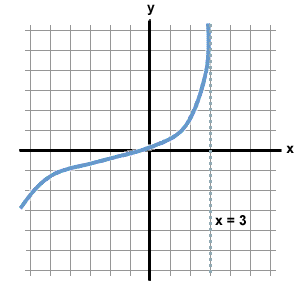
@Neodarwinian That would be true of an entirely natural system. With humans adding more CO2 at an ever increasing amount, and with atmospheric CO2 half-life nearly 40 years, we would not expect a sigmoid function. Also, while 57% of the annual CO2 emissions go into the atmosphere, the bulk of the remainder is absorbed by the oceans, thereby increasing their acidity. Acidic poisoning of aquatic plant life will further reduce the nature’s ability to mitigate the damage we humans are doing. I would not expect an leveling asymptote any time soon. More likely, unless we take very meaningful steps to halt the damage, it will be a vertical asymptote like this.
@ETpro
Huh!?!
I suggest you review the Calvin cycle and carbon fixation. This is a ” mechanical ” process that every plant goes through and this saturation point per plant is a common HS/college experiment showing the limits of enzyme activity.
” With humans adding more CO2 at an ever increasing amount, and with atmospheric CO2 half-life nearly 40 years, we would not expect a sigmoid function. ”
Does not matter to the individual saturation point. It varies per conditions, but you are talking about another matter.
Answer this question 
This question is in the General Section. Responses must be helpful and on-topic.



 Composing members:
0
Composing members:
0